

Free guide · Instant download
Moving to Manhattan? Start Here.
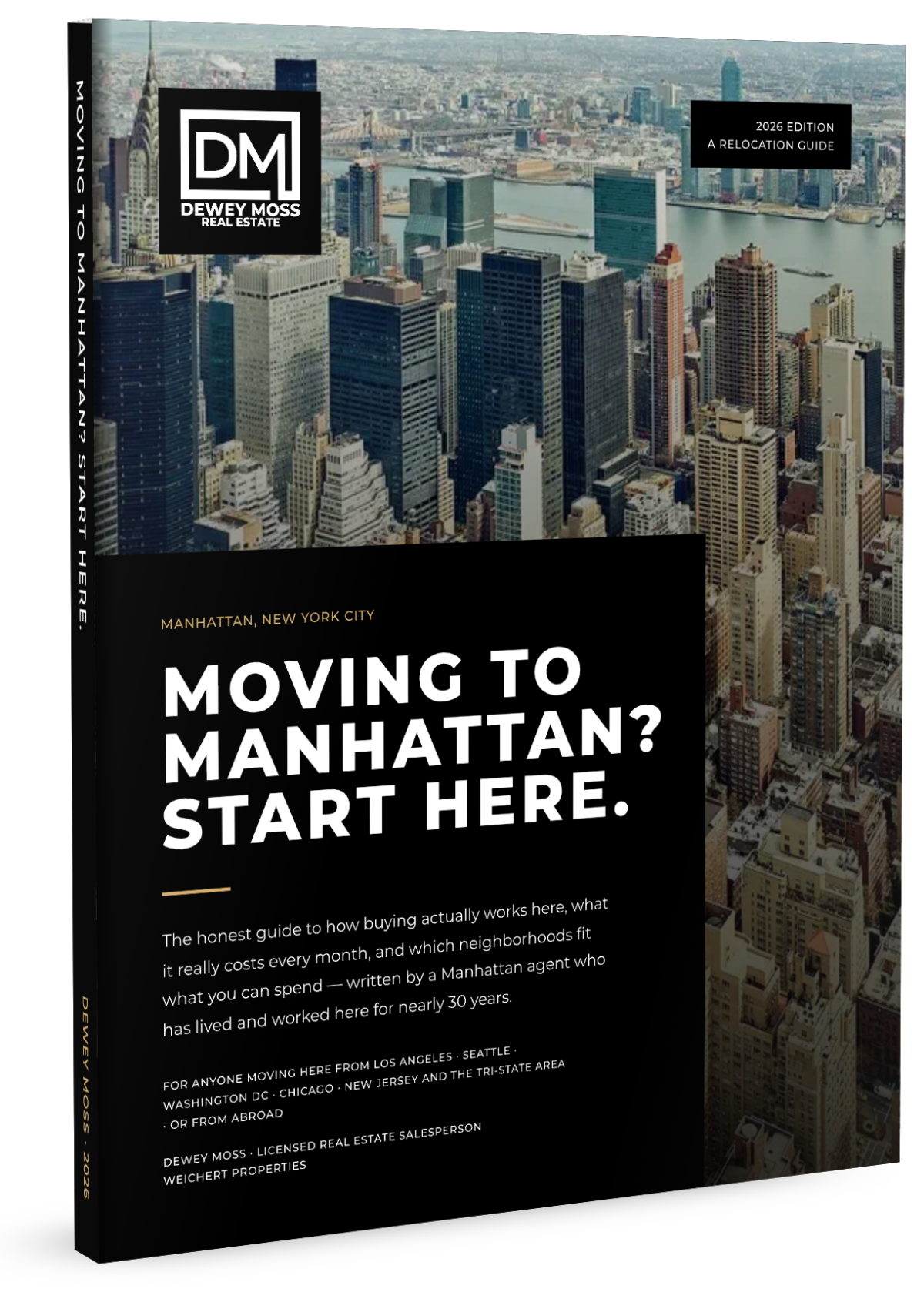
The honest guide to how buying actually works here, what it really costs every month, and which neighborhoods fit what you can spend — from a Manhattan agent of nearly 30 years, not a listings site.
Free. Instant download. No spam.
The problem
Most people moving to Manhattan do the same two things. They get pre-approved. Then they find an apartment online and fall in love with it. And a lot of them find out — weeks later, sometimes after an accepted offer — that the building was never going to let them buy it.

Here's what nobody tells you about New York City: the bank and the building are two completely separate approvals, on two completely different sets of criteria. A building can ask for one to two years of housing costs still sitting in the bank after you close. Many boards want your total debt-to-income under roughly 28%. Every building writes its own rules, and none of them are on the listing. Miss that and you lose months, and sometimes the apartment.
And that's before the part nobody budgets for: the monthly carrying charge that quietly decides what you can actually afford, the square footage that lands smaller than you pictured, and the fact that two blocks in either direction can change the price entirely.
You can know all of this before you start looking instead of after. That's what this guide is.
The guide
Moving to Manhattan? Start Here. — 6 topics, free.
What you'll get
- 01
The two approvals explained plainly — what your lender checks, what the building checks, and why being pre-approved tells you almost nothing about whether you can buy a given apartment.
- 02
What changes coming from where you are — a straight read whether you're moving from places like Los Angeles, Seattle, Washington DC, Chicago, New Jersey and the tri-state, London, or anywhere else. What's genuinely different, not a generic "NYC is expensive."
- 03
Five neighborhoods worth shortlisting from another city — Chelsea, the West Village, Greenwich Village, the Upper West Side and the Upper East Side, each with its price band, its building stock, and the one honest trade-off a local would warn you about.
- 04
The four things that surprise everyone once they live here — why the monthly number, not the price, decides your budget · what you actually get for the money · the building-class ladder from walk-up to full service · and why a couple of blocks changes everything.
- 05
The mistakes I watch relocating buyers make — including the structure problem that kills deals late, and why a listing photo is a movie trailer.
- 06
What to do and when — 6 to 12 months out, 3 to 6 months out, the last stretch, and the move-in rules most Manhattan buildings have that nobody plans for.
Why it's worth more than free
Search "moving to Manhattan" and you'll mostly find moving companies. This is the other half — the part about actually buying here, written by someone who has done it in this market for nearly 30 years and who is willing to tell you the unflattering parts.

Dewey Moss
Licensed Real Estate Salesperson
Weichert Properties · Union Square, Manhattan
About Dewey
I'm Dewey Moss. I've lived and worked in Manhattan for nearly 30 years, and I work almost entirely with people navigating this market's complexity — first-time buyers, relocations, parents purchasing for an adult child, and pied-a-terre buyers.
Co‑Ops are the large majority of what's for sale here and they're where most out-of-town buyers get caught out, so that's where I've gone deep. I handle Co‑Op board applications myself, start to finish. Not a team member. Me.
Why I'm qualified
Nearly 30 years in Manhattan, top salesperson in my Weichert Properties office, and Weichert Top 300 agents nationally in 2025.
My process — three steps
- 1
We qualify you against both standards — what a lender will approve, and what a building will approve. They are not the same bar.
- 2
We match your actual buying structure to the buildings that permit it, before anyone falls in love with an apartment.
- 3
Then we look — with a clear picture of what your real monthly number is.
I'm your advisor, not a door opener. My job isn't to tell people they can't buy. It's to make sure they're ready when they do. The decision is always still yours.

The local market
The five neighborhoods this guide is built around.
Communities I serve
Chelsea · West Village · Greenwich Village · Upper West Side · Upper East Side
(Tribeca and Soho when the budget reaches there.)

Chelsea
Condo medians roughly $2–3M
Condo-heavy by Manhattan standards, newer development along the High Line corridor, the gallery district west of Tenth Avenue. Condo medians have been running roughly $2–3M (PropertyShark / Milton Coste, 2026). Excellent transit.
The honest trade-off
Constant foot traffic from the High Line and the galleries.
West Village
Median roughly $1.6–1.9M
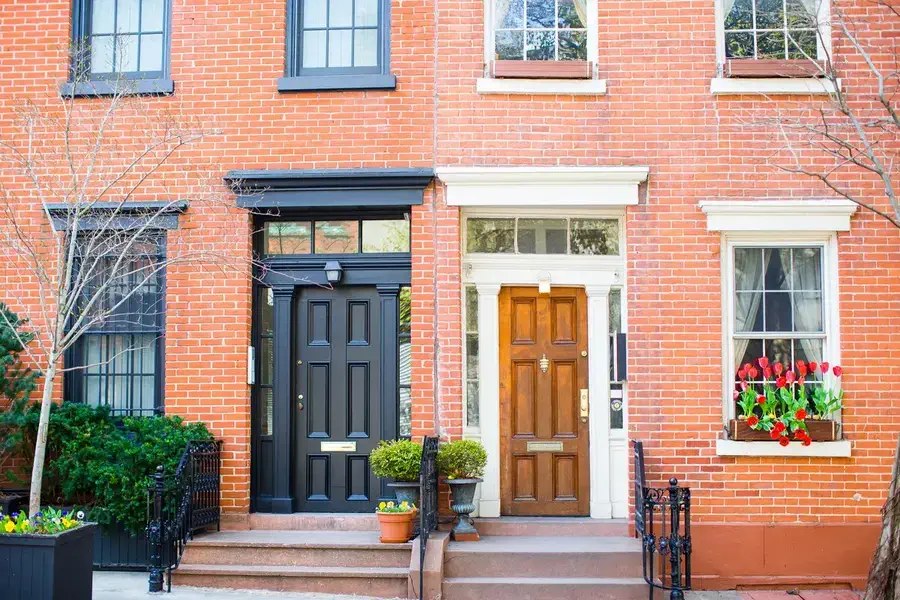
Low-rise prewar buildings and the least grid-like streets in Manhattan. Median sale prices roughly $1.6–1.9M, with Co‑Ops about 61% of the inventory (Milton Coste, May 2026) — so the board process matters more here than average.
The honest trade-off
Old buildings. Walk-ups are common and elevators are not a given.

Greenwich Village
Overlaps West Village; higher on prime blocks
The historic blocks around Washington Square Park — prewar Co‑Ops and a small number of boutique condos, pricing overlapping the West Village and higher on the prime blocks.
The honest trade-off
Tightly landmarked, so renovations take longer and cost more.

Upper West Side
Median sale around $1.2M
Prewar Co‑Ops between Central Park and Riverside Park, the most classic large layouts in Manhattan, and the best space-per-dollar of the five. Median sale around $1.2M (StreetEasy, 2026).
The honest trade-off
A high Co‑Op share means more boards and more applications, and prewar means older systems — in some buildings a washer/dryer isn't permitted in the unit at all.
Upper East Side
Median roughly $1.4–1.6M
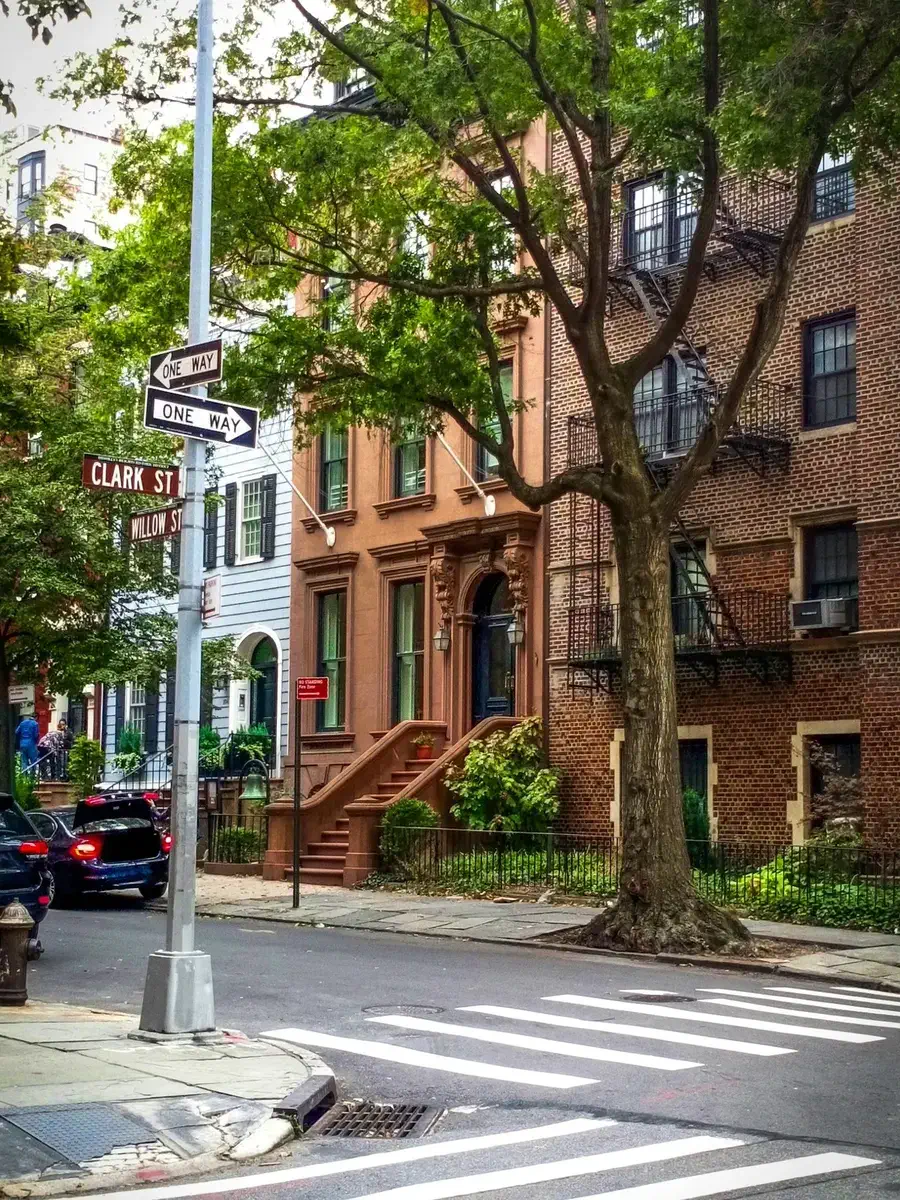
Prewar Co‑Ops near Central Park and Museum Mile, median roughly $1.4–1.6M (2026), with stronger values east of Lexington where the walk to a train is longer.
The honest trade-off
The most board-driven of the five.
A note on these numbers: they're directional 2026 reads, presented as ranges. Manhattan moves. Ask me for current figures before you make a decision on one.
Why my local depth matters to you
Manhattan is a city of neighborhoods on one small island, and the boundaries are real — two blocks can change the price, the building stock, and the walk to a train. From another city that is impossible to see. Knowing it is most of what keeps you from overpaying or landing on the wrong block.
Proof
People who did this from somewhere else.
Dewey's thoroughness and steady guidance gave us confidence, especially when walking us through the board application and ensuring nothing was overlooked. He truly set the bar high for what we expect from a realtor.
Evan MeisterRelocated from the West Coast, bought a condo on the Upper East Side.
As a person based outside of the US, I relied heavily on his ability to simplify a complex process. His knowledge of the city is exhaustive, covering everything from neighborhood vibes to the fine print of building logistics and price negotiations. Dewey is a true local expert who makes the impossible feel easy.
KurtBuying from outside the United States.
I've bought and sold properties in multiple states, but nothing prepared me for buying in New York City. There were all sorts of extra forms and steps, and I had no idea what any of them were or how to approach the process, but Dewey did.
Herman B.Had bought and sold in multiple states before New York.
Searching for a first apartment/space, for your adult child, out of state can be daunting. Dewey Moss immediately put us at ease with his care, expertise and knowledge of the NY area... We truly felt heard!
Vicki JohnsonParents in Texas, buying a first apartment for an adult child.
30yrs
Nearly 30 years living and working in Manhattan
No.1
Top salesperson in his Weichert Properties office
300
Weichert Top 300 agents nationally, 2025
5.0
Rating on both Google and Zillow
Every one of those clients started where you are — somewhere else, competent, experienced, and wrong about one specific thing: how this market works. That's the normal case here, not the embarrassing one.

Follow along
I answer these questions on camera every week — how Co‑Op boards actually decide, what the monthly numbers really look like, and what buyers moving here get wrong. Most of the people I work with found me there first. This guide is a sample of it.
The free guide
Moving to Manhattan? Start Here. — the free guide.
Top 3 you'll get
- 01
Why being pre-approved doesn't mean you can buy here — and what the building checks instead
- 02
Five neighborhoods worth shortlisting from another city, with price bands and the honest trade-off of each
- 03
What to do 6–12 months out, 3–6 months out, and in the final stretch
Free. Instant download. No spam.
Quick answers
- Is this a sales pitch?
No. It's the guide. If you ever want help, you know where I am.
- Will I get spammed?
No. It downloads instantly, and you can unsubscribe from anything anytime.
- I haven't even decided if I'm moving — is this for me?
Then this is exactly the thing to read before you decide. No commitment, just the honest picture.